The measurable standard
for home health.

We measure your home's air, establish your baseline, and continuously raise the standard.

Not ready? Get the free Indoor Air Quality guide →

Baseline Score 74 / 100 Sample report
PM2.5 14.2 μg/m³ Above EPA 9.0 threshold
CO₂ Level 683 ppm Below 800 ppm sleep threshold
Humidity 26% Below 30% optimal range

Most homes are
never measured.

The air in your home is actively shaped by your HVAC system, your building materials, your daily activity, and what drifts in from outside. Each home is different. None of them come with a dashboard.

2-5x
higher pollutant concentrations indoors vs. outdoors, per EPA research
U.S. EPA
800 ppm
CO₂ threshold above which sleep quality is measurably affected
ASHRAE 1837-RP
40-60%
target humidity range. LA's dry climate routinely pushes homes below it, stressing mucous membranes and increasing viral transmission.
Sterling 1985 / EPA
90%
of time Americans spend indoors. Indoor air is almost never measured
U.S. EPA

U.S. Environmental Protection Agency · ASHRAE 1837-RP · NIH/PMC

Fine Particles (PM2.5)

Particles fine enough to reach the bloodstream enter through gaps, ductwork, and HVAC returns. In LA County, wildfire smoke and traffic exhaust are persistent sources. Research found 85% of homes had indoor PM2.5 above the EPA's own outdoor air standard.

VOC Accumulation

EPA research found VOC concentrations inside homes 2 to 5x higher than outdoors regardless of location. Sources include paints, cleaning products, furnishings, and personal care products. During painting or cleaning, levels can spike to 10x outdoor concentrations.

CO₂ and Ventilation

Research across 100+ households found bedroom CO₂ above 1,150 ppm measurably disrupts sleep and next-day cognitive performance. Most homes with closed doors and no mechanical ventilation regularly exceed that level overnight.

Indoor Humidity

LA's dry climate, compounded by air conditioning and forced-air heating, routinely pushes homes below the 40 to 60% optimal range. Low humidity dries the mucous membranes that defend against airborne pathogens and is linked in peer-reviewed research to disrupted sleep and increased infection vulnerability.

Radon

A naturally occurring radioactive gas and the leading cause of lung cancer in non-smokers, responsible for approximately 21,000 deaths per year in the US. It enters silently through foundation cracks and soil contact. Most California homeowners have never tested. Most who have elevated levels had no idea.
Residential neighborhood in the Los Angeles area
Why This Exists

It started with a
Nextdoor thread.

In 2022, a chance conversation online led to the discovery that our family home in West Hills had nearly four times the EPA's maximum recommended radon level. Our kids had been breathing it for years. We had no idea. Baseline exists because protecting your family's health should not depend on a lucky thread.

“Have you ever tested your home for radon? It is a naturally occurring gas that is the leading cause of lung cancer in non-smokers.”

14
picocuries per liter found in our home. The EPA action level is 4 pCi/L. We were at nearly four times that. No symptoms. No warning. No way to know without testing.
21K
Americans die from radon-related lung cancer each year per the EPA. It is the leading cause of lung cancer in non-smokers. Most of those homes were never tested.
90%
of a person's life is spent indoors. The air quality in those spaces is almost never measured, tracked, or actively managed. That is the problem Baseline exists to solve.
The Baseline Air & Health Reference

Your air.
Your body.

The pollutants in your home don't just irritate the lungs. They reach the bloodstream, the heart, the brain. Here are four of the ten that matter most — and what they actually do to the people living in your house.

Los Angeles highway obscured by wildfire smoke and orange haze

Southern California

The outside air finds its way in.
Baseline measures what gets through.

Clean MERV air filter close-up showing filtration media
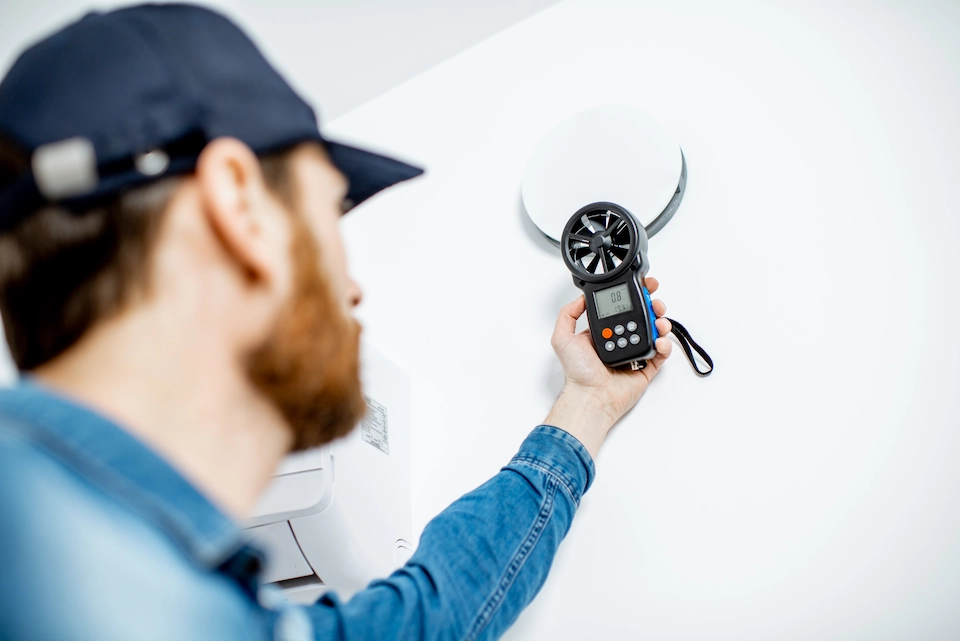
Technician measuring home air quality with anemometer
Baseline
Baseline Score 74 Your home, quantified.
Assessment Report
Pillar Scores
Ventilation
43
Filtration
82
Humidity
29
Each pillar maps to an upgrade package.

How the Partnership Starts

Establishing your baseline is the entry point. Not the product.

Most home service companies show up, do a job, and leave. Baseline is different. The assessment establishes your home's starting point. A measured, documented record of where things stand. Everything after that is optimization, maintenance, and improvement over time.

01

Indoor Air Quality Measurement

We deploy calibrated sensors throughout your home measuring PM2.5, VOCs, CO, CO₂, NOx, temperature, and humidity at the room level, not just at the thermostat. Data is collected over the visit window and compiled into your Baseline Report.
02

HVAC Visual Inspection

A trained technician assesses filter condition, duct visual, system age, airflow by room, and thermostat configuration. If the data or inspection suggests deeper mechanical issues, we recommend a targeted diagnostic as a next step. Clearly scoped, never a surprise.
03

Your Baseline Report and Partnership Plan

A scored performance report across three pillars: ventilation, filtration, and humidity. Category breakdowns, prioritized action plan, and a clear recommendation for the Baseline Home Plan and any packages relevant to what we found.
$195 flat, applied toward any service
A Note on Radon
Radon is handled separately, not in the assessment.
A credible radon reading requires weeks of sensor dwell time, not a 90-minute visit. We don’t pretend to capture it at the assessment. If your home has the risk factors (certain foundation types, geology, or prior elevated readings), we’ll flag it in your Baseline Report and you can add continuous Radon Monitoring as a membership upgrade. Your readings are yours. If anything sustained crosses the EPA action level, we refer you to a certified mitigator.
Monitoring
Membership upgrade
Baseline Score 74 Your home, quantified.
Ventilation
43
Filtration
82
Humidity
29
Each pillar maps directly to an upgrade package. Low scores have a clear path forward.

Your Home, Quantified

Three pillars. One honest number.

Your Baseline Score is built on three measured pillars: ventilation, filtration, and humidity. Each one maps directly to an upgrade package. Low ventilation score means CO₂ or VOC levels that warrant an ERV. Low filtration score means your HVAC system is not capturing what it should. Low humidity score means conditions that compromise sleep, immunity, and comfort every single night.

The score is not a snapshot you file away. It is the starting point for a conversation about what your home needs, in what order, and how a Baseline Home Plan keeps it optimized year over year. EPA research shows indoor pollutant levels vary 2 to 5x from home to home. Your number is yours alone.

Get the Free Guide

Family relaxing in warmly lit home interior at night

You can't improve
what you haven't measured.

Baseline changes that.

Membership Plans and Upgrade Packages

Two plans. One ongoing relationship.

Your assessment identifies exactly what your home needs. From there, you choose the level of ongoing monitoring, service, and support that fits your home and how you want to manage it. Both plans include the standard HVAC preventive maintenance a typical service contract would cover, so you are not paying for two overlapping contracts. The upgrade packages address what the assessment found — each one solves a specific, measured problem.

The Membership
Baseline Home Plans
Two tiers. Both include sensors, monitoring, and an ongoing service relationship.
Every Baseline membership includes Baseline-owned sensors installed in your home, ongoing air quality monitoring, and a scheduled service relationship. Each visit is a System & Air Quality Service — a full HVAC preventive maintenance plus an air quality re-validation — so the membership replaces a standalone HVAC service contract rather than sitting alongside one. The plan you choose determines how many sensors, how often we visit, and how deeply we manage your system over time.
  • Active PlanCentral plus one room monitor, two System & Air Quality Service visits per year, proactive monitoring, automation tuning, filters included, and member pricing on all upgrades and services.
  • Performance PlanFull coverage. Central plus two room monitors, quarterly System & Air Quality Service visits, duct pressure diagnostics, ventilation balancing, 10% off upgrades, and a guaranteed 48-hour response window.

Prefer not to commit to a membership? Hardware can be purchased outright with professional installation; ongoing service is available à la carte.

Common Question
Do I still need an HVAC service contract?
No. Every Baseline System & Air Quality Service visit includes the standard HVAC preventive maintenance a typical residential service contract covers — filter replacement, coil inspection, condensate drain check, blower and belt inspection, refrigerant charge observation, electrical and thermostat checks, and safety and combustion inspection where applicable. Your membership is designed to replace that contract, not sit on top of one.
Common Question
What about radon?
Radon is available as a continuous monitoring add-on for members, not as part of the one-time assessment. A credible radon reading requires weeks of sensor dwell time, not a 90-minute visit, so we don’t pretend to capture it during the assessment. Instead, if your home has the risk factors — certain foundation types, geology, or prior elevated readings — we’ll flag it in your Baseline Report and you can add a continuous radon monitor to your membership. Your readings are yours, and if anything sustained crosses the EPA action level we refer you to a certified mitigator.

Triggered by what your assessment finds. System upgrades address the physical infrastructure that moves and conditions your air. Continuous sensors give you year-round visibility into what it is doing.

System Upgrades
+

Fresh Air and Ventilation

CO₂ control · VOC dilution · ERV installation
Most Common
We design and install an energy recovery ventilator (ERV) sized to your home and calibrated to your existing HVAC system. An ERV brings filtered outdoor air in while recovering heating or cooling energy from outgoing air, keeping the exchange efficient year-round. This dilutes CO₂ and VOC buildup and keeps bedroom levels in the range where sleep and cognitive performance are not compromised. ASHRAE research indicates most homes need at least double their current ventilation rate to maintain healthy bedroom CO₂. This is the upgrade most assessment results point to first.
+

Advanced Filtration

PM2.5 reduction · Particle control · Wildfire defense
We upgrade your HVAC filtration to a high-efficiency system appropriate for your equipment and validate the result with sensor data, not just a filter spec sheet. Where HVAC filtration alone cannot reach target PM2.5 levels, we recommend supplemental HEPA filtration for key rooms. Research found HEPA filtration improved asthma symptoms and quality of life in children with uncontrolled asthma. Filtration is the most direct lever for reducing indoor particle exposure, particularly during wildfire season in LA County.
+

Humidity Control

Whole-home humidification · Fan-assisted installation
We install a fan-assisted evaporative whole-home humidifier integrated with your HVAC system. Fan-assisted means it operates any time the air handler is running, not only during heating cycles, which matters in LA where cooling runs far more than heat. This type of humidifier works through natural evaporation, so minerals stay in the pad rather than entering the air you breathe. We do not install ultrasonic humidifiers. Triggered by humidity assessment findings below the 30 to 50% range that supports immune function, sleep quality, and respiratory health. Pad replacement is included in your annual Baseline Home Plan visit.
Continuous Sensors

Your assessment is a snapshot. These keep the picture live.

+

Continuous Monitoring

Whole-home sensor network · Year-round visibility
We install permanent calibrated sensors throughout your home and ductwork measuring PM2.5, VOCs, CO₂, temperature, and humidity year-round. Your data is continuously monitored and flagged between visits if values shift meaningfully. For homes that want a live picture, not just an annual snapshot, and for members who want to see the impact of their upgrade packages over time with real before-and-after data.
+

Low-Level CO Monitor

Continuous CO detection · Gas-appliance safety
Standard UL-listed CO alarms only trigger at 70 ppm after sustained exposure: the threshold designed to prevent acute poisoning, not chronic harm. We install a low-level CO monitor calibrated to alert at 5 ppm and above, the range where headaches, fatigue, and cognitive symptoms begin. Particularly relevant for homes with gas furnaces, gas cooktops, attached garages, or fireplaces. Your assessment includes a handheld CO sweep; this upgrade provides continuous protection year-round.
+

Radon Monitoring

Ongoing radon detection · Integrated with your Baseline dashboard · Year-round visibility
We install a continuous radon monitor and integrate it directly into your Baseline dashboard, alongside your PM2.5, VOCs, CO, CO₂, and humidity data. One dashboard, every reading. Radon levels shift seasonally with weather, foundation pressure, and ventilation patterns, so a single test cannot tell the full story. Continuous monitoring catches the spikes, confirms mitigation is working, and gives you ongoing visibility year after year. Strongly recommended for homes that have completed mitigation, homes in the Simi or San Fernando valleys where soil geology elevates risk, and any home that wants a complete air quality picture. This is continuous monitoring, not the compliance-grade long-term assessment. The $295 Radon Assessment add-on remains the statistically valid baseline measurement.
The Baseline Way

Measured first. Managed always.

Common Questions

Questions we hear at the kitchen table.

+

Is the $195 assessment credited toward my membership?

No. The $195 covers the assessment itself: calibrated sensors on-site, the full HVAC visual inspection, and your Baseline Report. It credits toward any mechanical upgrade package we recommend (Fresh Air and Ventilation, Advanced Filtration, or Humidity Control). It does not apply toward a membership plan or a hardware-only purchase. Think of it as the cost of establishing the baseline, not a deposit on what comes next.
+

Does a Baseline Home Plan replace my HVAC service contract?

Yes. Every System & Air Quality Service visit includes the standard HVAC preventive maintenance a residential service contract covers: filter replacement, coil inspection, condensate drain check, blower and belt inspection, refrigerant charge observation, electrical and thermostat checks, and safety and combustion inspection where applicable. The Active plan handles this twice a year; Performance handles it quarterly. The membership is designed to replace your service contract, not sit on top of it.
+

Why isn't radon testing part of the assessment?

Because a credible radon reading takes weeks of sensor dwell time, not a 90-minute visit. Short-term snapshots are noisy and easy to misread, and certified one-time testing is a regulated specialty in California. Baseline’s answer is continuous, not one-shot: Radon Monitoring is a membership upgrade that installs a dedicated radon monitor in your home and tracks seasonal shifts, confirms mitigation is working, and catches spikes year after year. If your Baseline Report flags elevated risk and a sustained reading crosses the EPA action level, we refer you to a certified mitigator for confirmation testing and remediation.
+

Do I own the hardware at the end of my membership term?

Yes. The central air monitor, controller, and room monitors bundled into your plan transfer to you at the end of your 12, 24, or 36-month term. If you continue, the equipment stays in service as-is. If you leave, the hardware stays with the home. Nothing gets ripped out.
+

Can I buy the hardware without signing up for a plan?

Yes. The hardware-only path is professional install at a flat price: Central Air Monitor and Controller installed is $650, room monitors are $200 each. You get the consumer app, live IAQ data, and default automation settings. You do not get proactive monitoring, automation tuning, filter service, priority scheduling, or member pricing on upgrades. It is the right call when you want measurement without a service relationship. Most hardware-only customers convert to a plan within the first year once they see what the alerts surface.
+

I already have a smoke and CO alarm. Why would I need a low-level CO monitor?

Standard UL 2034 alarms are designed to prevent acute poisoning. They trip at 70 ppm after sustained exposure: the threshold for keeping you out of an ambulance, not for keeping you feeling well. Chronic symptoms from low-level CO (headaches, fatigue, cognitive fog) begin well below that. A low-level monitor detects and alerts from 5 ppm upward. If your home has gas appliances, an attached garage, or a fireplace, it's the difference between knowing something is wrong and living with feeling off.
+

What happens if I don't decide at the time of the assessment?

Nothing punitive. You keep your Baseline Report, and your $195 credit toward a mechanical upgrade stays open. If you later decide to sign a membership or add hardware on a return visit, a $195 service-call fee applies to cover the separate trip. That fee is waived when the work happens during the original assessment visit. It's not a penalty; it's the honest cost of a truck roll.
+

Why only two plans?

Because a third tier didn't earn its keep. The Active plan covers the service relationship most homes need. Performance adds zone-level monitoring and quarterly diagnostics for homes where the assessment found something complex. Anything in between was a marketing choice, not a product one. It complicated the decision more than it helped. Two plans, one hardware-only path, and clear triggers for when each is the right answer.

baselinehomehealth.com

Your home deserves a
long-term partner.

Not a one-time inspection. Not a sales visit. A measured starting point, a clear plan, and ongoing support to keep your home performing at its best, year after year. Your membership replaces a standalone HVAC service contract, not adds to it.

90-minute visit.

Starting with air. Building toward whole-home health.

Get in Touch
Questions about the assessment, service area, or whether Baseline is right for your home.

Call or Text 818-237-3404